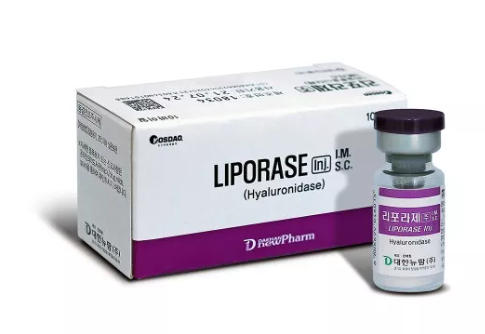
What types of fillers can Liporase be used to correct?
Liporase (hyaluronidase) is primarily used to dissolve hyaluronic acid (HA)-based fillers. Therefore, it is suitable for the correction and reversal of hyaluronic acid-based filler treatments. Specifically, it is applicable to the following situations:
Correction of over-injection of hyaluronic acid fillers
Correction of uneven distribution or localized lumps of hyaluronic acid fillers
Situations where rapid dissolution of HA is needed in case of accidental injection into the wrong area
Situations requiring rapid volume reduction and contour adjustment
Situations where it is not applicable:
Liporase should not be used with fillers that are not hyaluronic acid-based (such as poly-L-lactic acid, polycaprolactone, and other non-HA materials), as it only dissolves hyaluronic acid.
It should be used with caution in patients with infection or inflammation in the soft tissue, or those with allergies to enzyme preparations, and its use should be determined after a physician's assessment.
How long do the effects of Liporase last?
The effects and duration of Liporase (hyaluronidase) are influenced by several factors. Below is a clear summary of key points to help you understand the general situation:
Mechanism of Action and Initial Effects
Liporase works by breaking down the molecular structure of hyaluronic acid (HA) fillers, rapidly reducing filler volume and localized swelling. Significant changes are usually observed within a few hours to a few days after injection.
Duration of Effects
The duration of the effects and the degree of stability typically depend on the extent to which the filler is dissolved, the treatment area, the injected dose, and individual metabolism and tissue response.
Commonly, a new, relatively stable state is achieved within days to weeks. For dissolved fillers, the original contours may partially return, but this can also vary depending on individual differences.
Potential need for further treatment:
If the goal is permanent improvement, Liporase is only a temporary tool used to adjust or reverse the effects of excessive or uneven injections. Further treatment may still be needed, including additional fillers, alternative materials, or waiting for the tissue to naturally metabolize and recover.
Influencing Factors:
Injection dosage and location: The larger and more widespread the area treated, the more complex the results, and the longer or more variable the duration of effect.
Filler type: Liporase is only effective on hyaluronic acid (HA)-based fillers; the dissolution rate may also vary slightly between different brands of HA.
Tissue condition and metabolic rate: Age, skin condition, inflammation, etc., can also affect the dissolution and remodeling process.
Risks and Precautions
Risks such as excessive dissolution, local tissue reactions, and short-term pain or swelling exist. The procedure should be performed under the guidance of an experienced physician.
After the injection, follow the doctor's instructions for aftercare, avoiding vigorous pressing or rubbing of the treated area until the doctor confirms it is safe.